

The Pinocchio Story
Table of Contents
Chapter 1: The Magical Piece of Wood
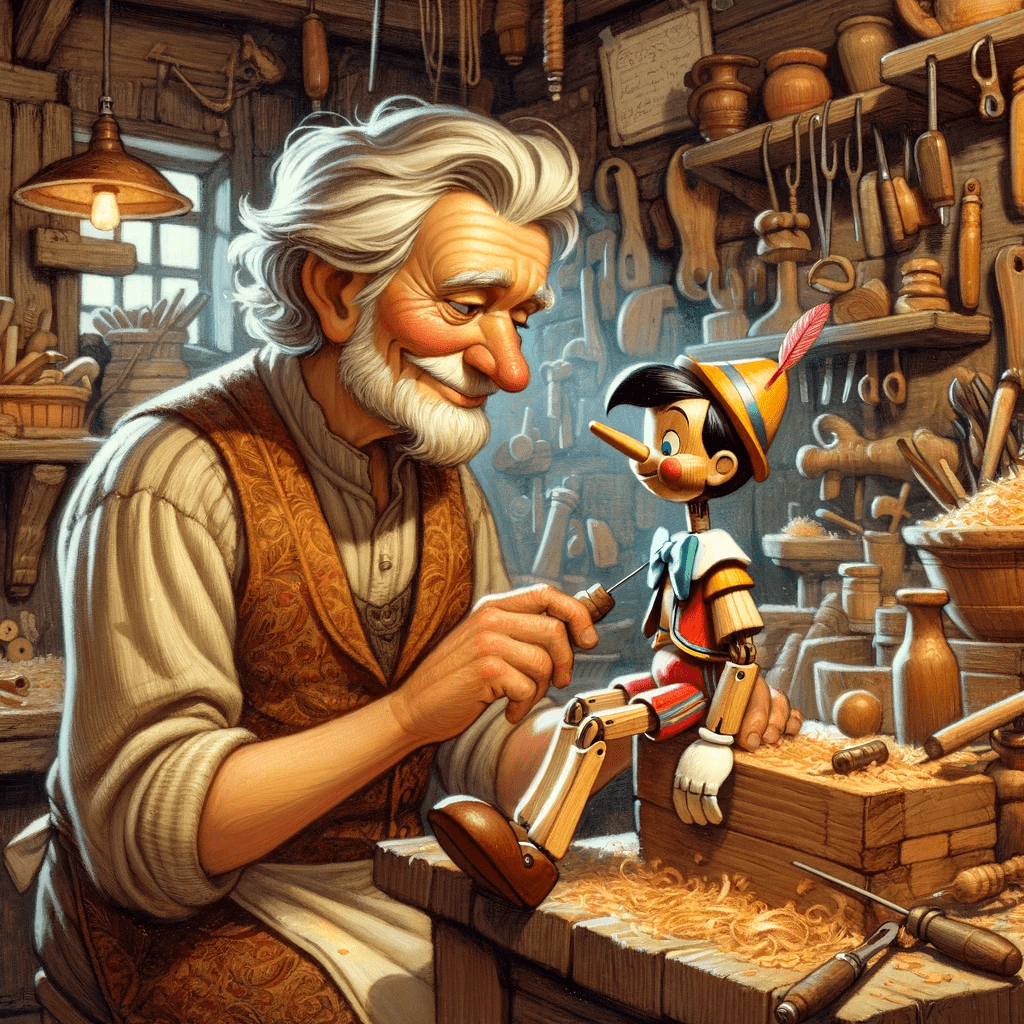
In a small, cozy workshop filled with the scent of wood shavings and the sound of cheerful whistling, lived a kind-hearted carpenter named Geppetto. He spent his days carving beautiful toys and intricate clocks, but deep in his heart, he longed for a son.
One day, Geppetto found a unique piece of wood that seemed to hum with magic. As he carved, he decided, “I will make a puppet, a marvelous boy puppet! I shall call him Pinocchio.”
Geppetto worked tirelessly, his skilled hands shaping the wood. As he carved the puppet’s nose, to his amazement, it began to wiggle! “Bless my tools! You’re already full of life!” he exclaimed.
The puppet’s eyes blinked open, sparkling with curiosity. “Hello, Father!” Pinocchio chirped, his wooden limbs creaking as he moved.
Geppetto gasped, his heart overflowing with joy. “My son, Pinocchio! You can speak and move!”
Pinocchio looked around with wide, wonder-filled eyes. “Yes, Father! But what is this place? And what am I?”
“This is my workshop, and you, my dear boy, are a very special puppet,” Geppetto explained with a warm smile.
Pinocchio’s wooden face lit up. “A puppet? Can I walk and play like other children?”
Geppetto nodded. “Of course, but first, you must learn about the world. It’s filled with wonders and dangers.”
“I want to learn everything!” Pinocchio exclaimed, his enthusiasm as infectious as his smile.
“And you will,” Geppetto promised. “But remember, being brave and truthful is the key to happiness.”
Pinocchio, eager for adventure, nodded earnestly. “I will be brave and always tell the truth!”
Thus began the extraordinary tale of Pinocchio, a puppet boy with a heart full of dreams and a world of adventures awaiting him.
Chapter 2: The First Adventure
The next morning, the sun shone brightly as Geppetto finished a small pair of shoes and a tiny hat for Pinocchio. “Now you look like a real boy!” he said, admiring his work. “Today, you will go to school like other children.”
Pinocchio, dressed in his new clothes, felt a burst of excitement. “School? What’s that, Father?”
“It’s a place where you learn about the world, make friends, and grow wise,” Geppetto explained.
On his way to school, Pinocchio’s head swiveled in every direction, marveling at the bustling streets and the children playing. Suddenly, he heard enchanting music and saw a colorful puppet show in the distance. “A puppet show! I must see it!” Pinocchio thought, forgetting Geppetto’s instructions.
He ran to the show, spellbound by the dancing puppets. The Puppet Master, seeing Pinocchio, was amazed by his life-like movements. “A walking, talking puppet without strings! You will be the star of my show!” he exclaimed, offering Pinocchio a handful of gold coins.

Pinocchio, dazzled by the applause and the gold, agreed, thinking, “I’ll go to school tomorrow. Today, I’ll be a star!”
Meanwhile, Geppetto waited at home, growing more worried as the hours passed. “Where could Pinocchio be?” he wondered.
Back at the puppet show, Pinocchio was a sensation. The audience loved him, and he basked in the attention. But as the night grew late, he remembered Geppetto’s worried face and felt a pang of guilt.
“I must go home to Father,” Pinocchio decided. “He must be so worried!”
But when he tried to leave, the Puppet Master locked him in a cage. “You’re my star now. You can’t leave!” he sneered.
Pinocchio realized his mistake. He should have listened to Geppetto and gone to school. As he sat in the cage, he wished he had made a different choice.
That night, a beautiful Blue Fairy appeared before Pinocchio. “Why are you not at home or in school?” she asked gently.
Pinocchio, scared and ashamed, lied, “I was going to school, but I was kidnapped!”
As he spoke, his wooden nose began to grow longer. Pinocchio touched his nose in surprise. “Why is this happening?” he cried.
“Pinocchio, your nose grows when you lie,” the Blue Fairy said. “To be a real boy, you must learn to be honest.”

With a wave of her wand, she freed Pinocchio and returned his nose to normal. “Remember, truth and bravery lead to happiness,” she reminded him.
Pinocchio nodded, his heart heavy with regret. “I will be truthful and brave,” he promised.
With a new resolve, Pinocchio set off for home, determined to be honest and to make Geppetto proud. Little did he know, more adventures were just around the corner.
Chapter 3: The Lesson of the Talking Cricket
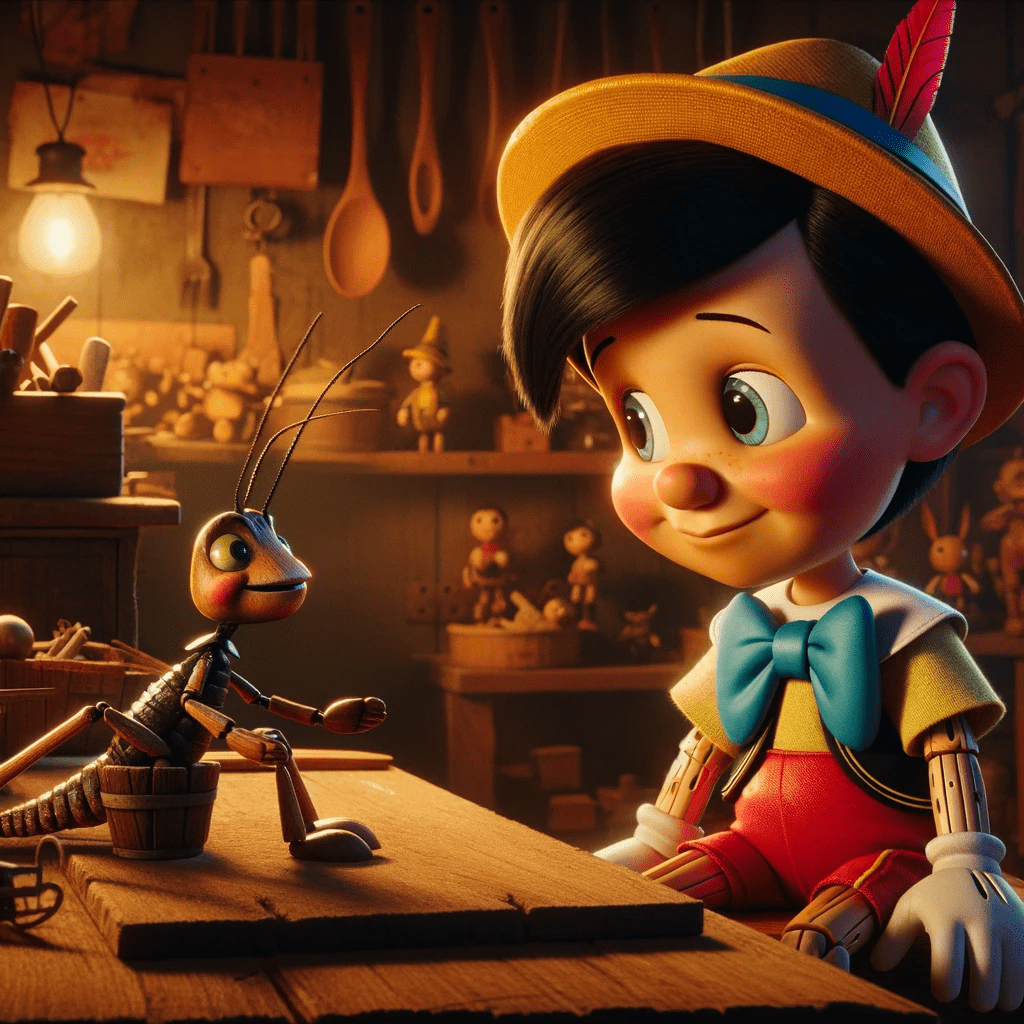
Pinocchio hurried home through the moonlit streets, eager to see Geppetto. As he entered the workshop, he found it empty and silent. “Father must be out looking for me,” he thought, feeling a pang of guilt.
As Pinocchio waited, a small, wise-looking cricket hopped onto the table. “Hello, Pinocchio. I am the Talking Cricket, and I’ve lived in this workshop for a hundred years,” the cricket said.
Pinocchio, surprised, replied, “Hello, Mr. Cricket. I’m waiting for my father.”
The Cricket, sensing an opportunity to impart wisdom, said, “Pinocchio, your adventures today show a lack of wisdom. School is important, and so is listening to your father.”
Pinocchio, still feeling rebellious, scoffed, “I don’t need advice! I can take care of myself.”
The Cricket, undeterred, continued, “Being honest and obedient will lead you to happiness. Disobedience only brings trouble.”
Pinocchio, annoyed, shouted, “Be quiet! I don’t want to listen!” In a moment of frustration, he threw a hammer at the Cricket, who dodged just in time and disappeared with a disappointed shake of his head.
Alone and regretful, Pinocchio whispered, “I’m sorry, Mr. Cricket. You were only trying to help.”
Just then, Geppetto returned, tired and worried. Seeing Pinocchio, his face lit up with relief and joy. “Pinocchio, my son, you’re safe!”
Pinocchio ran into Geppetto’s arms, tears in his eyes. “I’m sorry, Father. I went to a puppet show instead of school and got into trouble.”
Geppetto hugged him tightly. “I’m just glad you’re home. Remember, making mistakes is part of learning, but you must always try to do what’s right.”
Pinocchio nodded, his heart swelling with love and a desire to be better. “I will, Father. I’ll go to school tomorrow, and I’ll be good. I promise.”
That night, Pinocchio went to bed with a new determination to be honest and obedient. He knew he had much to learn, but he was ready to try his best.
As the moon shone through the window, the Talking Cricket watched from a corner, a small smile on his face. “You’ll learn, Pinocchio,” he whispered. “You’ll learn.”
And so, Pinocchio’s journey continued, each day a step closer to becoming a real boy, with his heart full of dreams and lessons yet to be learned.
Chapter 4: The Field of Miracles
The next morning, filled with resolve to be good, Pinocchio set off for school. Along the way, he met a sly fox and a crafty cat who noticed the gold coins in his pocket. “Hello, young fellow! Where are you off to with such riches?” asked the Fox.
“I’m going to school,” replied Pinocchio proudly, showing them the coins. “I earned these last night.”
The Fox and the Cat exchanged knowing glances. “School? Why, with those coins, you could go to the Field of Miracles. Plant them there, and overnight, they’ll grow into a tree of gold coins!” the Cat said with a sly grin.
Pinocchio’s eyes widened in wonder. “A tree of gold coins? Really?”
The Fox nodded. “Yes, but it’s a secret known to only a few. We can show you the way.”
Tempted by the promise of endless riches, Pinocchio forgot Geppetto’s lessons and followed them.
They traveled until they reached a deserted field. The Fox pointed to a spot. “Plant your coins here, and by morning, you’ll be the richest boy in the world!”
Eagerly, Pinocchio buried his coins and imagined a future filled with gold. The Fox and the Cat, barely containing their laughter, told him to go to the village and return the next day.
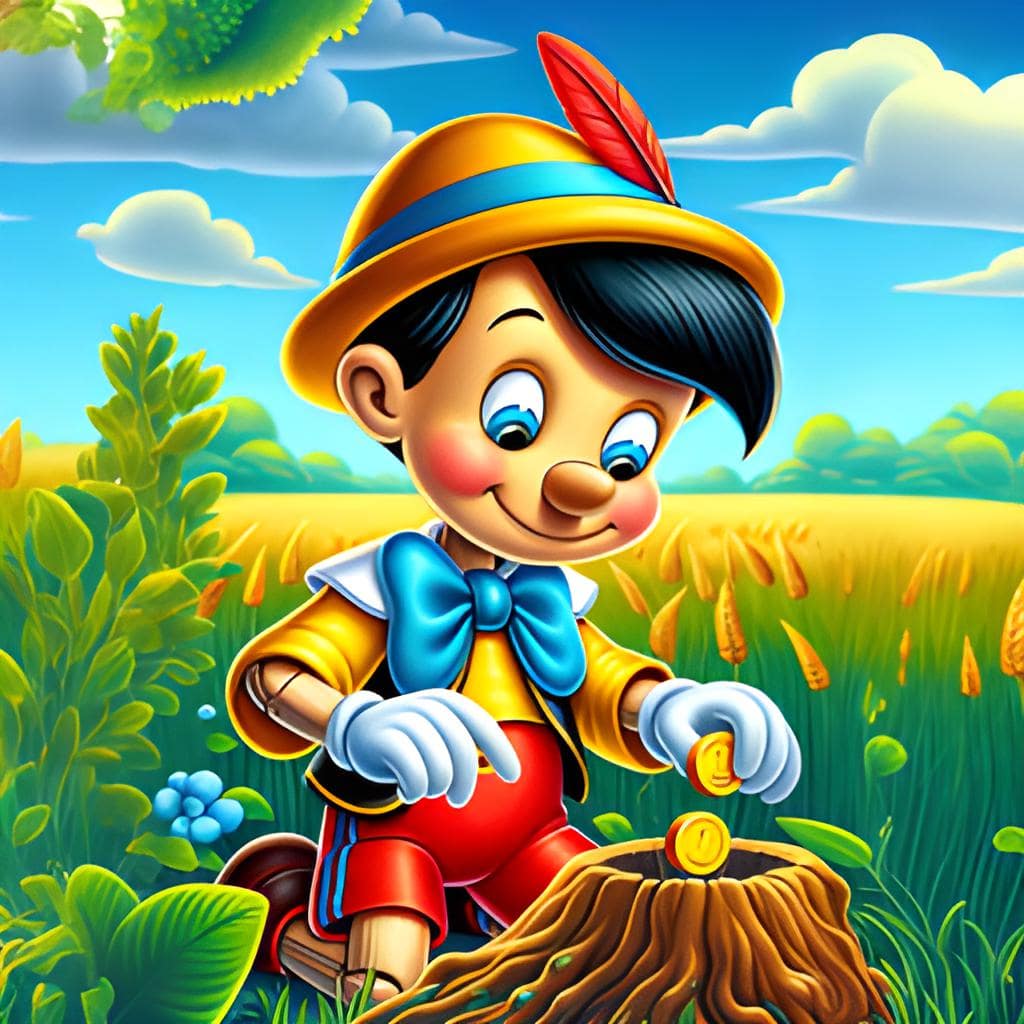
As Pinocchio left, the Fox and the Cat dug up the coins and disappeared.
The next morning, Pinocchio returned to find no tree, only the empty field. Realizing he had been tricked, he felt a deep sense of regret. “I should have gone to school. I should have listened to Father.”
Just then, the Blue Fairy appeared. “Pinocchio, why did you not go to school?” she asked.
Pinocchio, ashamed, admitted his mistake and the lie he had believed. The Fairy, kind but firm, said, “To be wise, you must learn to discern truth from lies and right from wrong.”
Pinocchio nodded, his heart heavy. “I’ve learned my lesson, Fairy. I’ll be more careful and listen to those who care for me.”
With a gentle smile, the Blue Fairy vanished, leaving Pinocchio to ponder his actions.
Determined to make amends, Pinocchio set off for home, now more committed than ever to his promise to be good and honest. He knew the journey would be challenging, but he was ready to face it with a brave heart and a truthful spirit.
Chapter 5: The Rescue in the Sea
Pinocchio trudged back home, his thoughts heavy with the day’s lessons. When he arrived, he found the workshop empty, with a note from Geppetto. It read, “Dear Pinocchio, I’ve gone to search for you by the sea. Please stay safe. – Father.”
Worried and guilty for causing more trouble, Pinocchio rushed to the sea. There, he learned that Geppetto had set out in a small boat to find him and hadn’t returned.
Without hesitation, Pinocchio dived into the churning waves, determined to find and rescue his father. The sea was vast and daunting, but his love for Geppetto gave him strength.
As night fell, Pinocchio, cold and exhausted, finally saw a small boat in the distance. It was Geppetto’s! But a fierce storm was approaching.
Braving the wild sea, Pinocchio reached the boat, only to find it empty. “Father!” he called, his voice lost in the roar of the wind and waves.
Then, from the depths of the sea, a gigantic whale emerged, swallowing Pinocchio and the boat whole.
Inside the whale’s belly, in complete darkness, Pinocchio found Geppetto, weak but alive. They embraced, tears of relief and joy mingling.
“Pinocchio, my brave boy, you came for me,” Geppetto said weakly.
“I’ll always come for you, Father,” Pinocchio replied. “We’ll find a way out together.”

They devised a plan. Pinocchio gathered pieces of wood floating in the whale’s belly and built a small fire. The smoke made the whale sneeze, sending them shooting out of its blowhole and back into the sea.
Clutching each other, they swam to the shore. Exhausted but safe, they lay on the beach, watching the stars.
“I’m sorry for all the trouble I caused, Father,” Pinocchio said. “I’ve learned so much. I want to be someone you can be proud of.”
Geppetto hugged him. “You are my son, Pinocchio. Your courage and heart make me proud every day. We’ll face the future together.”
As dawn broke, they walked home, their bond stronger than ever. Pinocchio had faced dangers and learned the value of honesty, bravery, and love. His journey had been long and filled with lessons, but he knew now that the true magic was not in becoming a real boy, but in the love and honesty he shared with his father.
Chapter 6: The Transformation
Back in the safety of their humble workshop, Geppetto and Pinocchio worked together, rebuilding what was lost and sharing stories of their adventures. Each day, Pinocchio went to school, his desire to learn and grow stronger than ever.
As the days passed, the people in the village began to notice the change in Pinocchio. He was no longer the mischievous puppet who skipped school for adventures. Instead, he was kind, helpful, and always truthful.
One evening, as Pinocchio returned from school, he found the Blue Fairy waiting for him. She smiled warmly at him. “Pinocchio, I have been watching you. You have shown great bravery, honesty, and love. You are no longer just a puppet.”
Pinocchio looked at her, eyes wide with wonder. “What do you mean?”
The Blue Fairy’s wand twinkled, and she touched Pinocchio’s forehead. “You have earned your heart’s desire.”
In a burst of magic, Pinocchio felt a transformation. He looked down at his hands, his wooden fingers now soft and alive. He was no longer made of wood but had become a real boy!

“Father! Father!” he shouted with joy, running into Geppetto’s arms.
Geppetto, tears in his eyes, hugged him tightly. “My Pinocchio, my brave, honest son.”
The villagers gathered, marveling at the miracle. Pinocchio, the real boy, smiled, his heart full of gratitude and joy.
From that day on, Pinocchio lived a happy life, filled with love and adventures, but always grounded in the lessons he had learned. He helped Geppetto in the workshop, continued his studies, and became a beloved figure in the village.
And in the quiet moments, when the stars shone brightly, Pinocchio would whisper a thank you to the Blue Fairy and the Talking Cricket, who had guided him on his journey.
Pinocchio’s story became a tale told throughout the land, a story of a puppet who became a real boy, a tale of magic, love, and the power of truth and bravery.
And so, Pinocchio’s adventures came to an end, but his story, filled with lessons and love, would live on forever in the hearts of those who heard it.

Moral Lessons of the Story:
- Telling the truth matters: Pinocchio’s nose famously grows when he lies, serving as a clear and tangible consequence for dishonesty. This teaches children the importance of truthfulness and the negative consequences of deceit. You can explore how honesty builds trust and fosters healthy relationships.
- Hard work and obedience pay off: Throughout his journey, Pinocchio faces challenges and temptations. However, when he chooses to work hard, follow good advice, and resist wrong paths, he finds success and redemption. This reinforces the value of diligence, listening to wise guidance, and making responsible choices.
- Kindness and compassion are crucial: Though often tricked and misled, Pinocchio eventually learns the power of kindness and compassion. Helping others, even at personal cost, brings rewards and personal growth. Discuss how showing empathy and caring for others leads to a happier and more fulfilling life.
- Learning from mistakes is possible: Pinocchio makes numerous mistakes, but they ultimately become opportunities for growth. He learns from his consequences, evolves his character, and becomes a better person. This teaches children that everyone makes mistakes, but the important thing is to learn from them and strive to improve.
- Family and love are powerful forces: Despite his flaws, Pinocchio is loved unconditionally by his creator, Geppetto. This enduring love guides him on his journey and ultimately helps him realize his true potential. Discuss the importance of family bonds and how love and support can overcome any obstacle.
Pinocchio is not just a cautionary tale, but also a story of hope and transformation. By learning from his mistakes and choosing good over evil, Pinocchio ultimately finds happiness and fulfillment. This provides a powerful message for children, encouraging them to believe in their own potential and strive for positive change.
Discussion Points
About Honesty and Integrity:
- “Why did Pinocchio’s nose grow when he lied? What does this teach us about telling the truth?”
- “How did Pinocchio feel after he told the truth?”
Understanding Actions and Consequences:
- “What happened when Pinocchio skipped school? What should he have done instead?”
- “Can you think of a time when your actions had unexpected consequences?”
Courage and Facing Challenges:
- “Was there a time in the story when Pinocchio had to be brave? How did he show his courage?”
- “Have you ever had to be brave like Pinocchio?”
Value of Education:
- “How did going to school help Pinocchio?”
- “Why is learning new things important?”
Respecting Elders and Listening to Advice:
- “Why is it important to listen to people like Geppetto and the Talking Cricket?”
- “Have you ever received advice that helped you?”
Family and Love:
- “How do Pinocchio and Geppetto show they love each other?”
- “What does this story teach us about family?”
Making Choices and Responsibility:
- “What could Pinocchio have done differently in the story?”
- “How do our choices affect others around us?”
These questions can stimulate more thoughtful responses and discussions, helping children to connect the story’s themes with their own experiences and understanding of the world.
Learn More About the Story
Lorem ipsum dolor sit amet, consectetur adipiscing elit. Ut elit tellus, luctus nec ullamcorper mattis, pulvinar dapibus leo.
Who wrote the story of Pinocchio?
The story of Pinocchio was written by an Italian author named Carlo Collodi. His real name was Carlo Lorenzini, but he used “Collodi” as his pen name, which he took from the Tuscan village where his mother was born.
When was the story of Pinocchio first published?
“The Adventures of Pinocchio,” the original story about the wooden puppet who dreams of becoming a real boy, was first published in 1883. Initially, the story was released in serial form in a children’s magazine in Italy and later compiled into a book.
Is Pinocchio based on a real boy or real events?
No, Pinocchio is a fictional character and the story is not based on real events. It’s a made-up tale, but it teaches important lessons about honesty, bravery, and family love.
Has the story of Pinocchio changed over time?
The basic story of Pinocchio remains the same, but there have been many adaptations in movies, books, and plays. Each version might have some changes or new elements, but they all tell the story of the wooden puppet who becomes a real boy.