

The Ant and the Grasshopper Story
In a sunny green meadow, there lived a hardworking ant named Annie and a joyful grasshopper named Garry. The sun shone bright, and the flowers danced in the breeze.
Annie the ant was always busy. She scurried around, gathering food. “Chop, chop, little ant,” she sang to herself, carrying a big grain of wheat. She was preparing for winter when food would be scarce.
Meanwhile, Garry the grasshopper loved to play. He hopped from leaf to leaf, singing merrily. “Why work so hard, Annie?” he chuckled. “Come and play with me!”

But Annie shook her head. “Winter is coming, Garry. We must prepare and store food,” she said wisely.
Garry just laughed and continued to play. “Winter is far away! There’s plenty of time,” he sang, hopping away.
Days turned into weeks, and weeks into months. The leaves turned orange and gold, and the air grew colder. Annie had gathered a lot of food and was ready for winter.
One chilly day, as the first snowflakes fell, Garry the grasshopper shivered. He had been so busy playing, he hadn’t gathered any food. Hungry and cold, he remembered Annie’s wise words.

Knocking on Annie’s door, he said, “Annie, I have no food and I’m so cold. Can you help me?”
Annie welcomed him in. “Of course, Garry. But remember, it’s important to prepare for the future,” she said kindly.
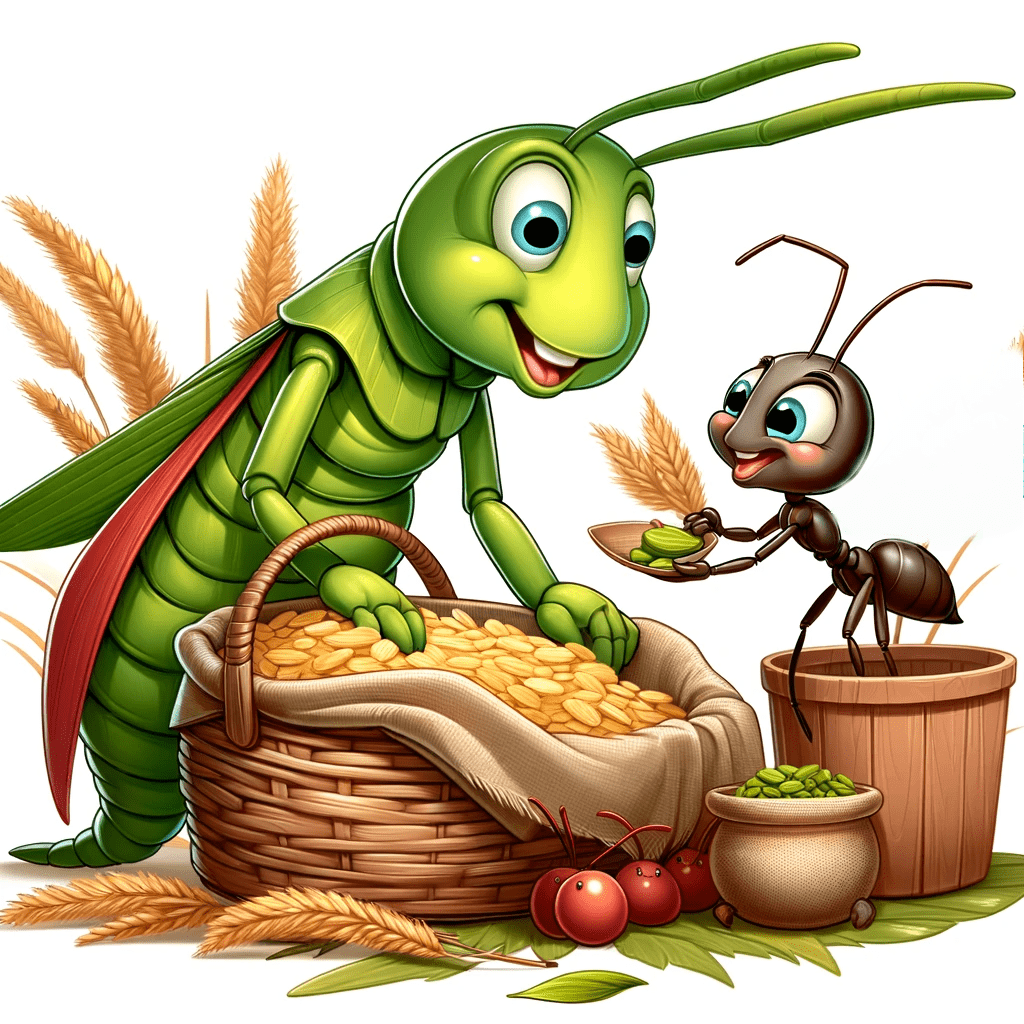
From then on, Garry learned to balance work and play. He helped Annie gather food, and they both had time for fun.
Moral Lessons of the Story:
The main moral of the story: It’s important to prepare for the future, but there’s always time for a little fun!
In addition to the primary moral of balancing preparation for the future with enjoying the present, “The Ant and the Grasshopper” offers several other valuable lessons:
- Value of Hard Work: The story teaches the importance of hard work and diligence. Annie’s dedication to gathering food highlights the virtue of being industrious and the benefits it brings.
- Consequences of Procrastination: Garry’s situation serves as a cautionary tale about procrastination. It illustrates that consistently putting off necessary tasks can lead to difficult situations and hardships.
- Empathy and Helping Others: Annie’s decision to help Garry, despite his earlier refusal to work, teaches empathy and kindness. It shows the importance of helping others in need, even if their situation is self-inflicted.
Discussion Points
Hard Work vs. Fun:
- Do you think it’s more important to work hard like Annie or to play and have fun like Garry? Why?
- Can you think of a time when you had to choose between working and playing?
Helping Others:
- Should Annie have helped Garry even though he didn’t work earlier? Why or why not?
- Have you ever helped someone who made a mistake? How did it feel?
Learning from Mistakes:
- What do you think Garry learned by the end of the story?
- Can you share a time when you learned something from a mistake?
Empathy and Kindness:
- Why is it important to show kindness, like Annie did?
- Can being kind to others make a difference? How?
Consequences of Actions:
- What were the consequences of Garry’s decision to play instead of work?
- Why is it important to think about the consequences of our actions?
Learn More About the Story
Where does the Ant and the Grasshopper story originally come from?
The fable “The Ant and the Grasshopper” is one of Aesop’s Fables, originating from ancient Greece. Aesop, a storyteller believed to have lived around 620–564 BCE, is credited with a number of fables now collectively known as Aesop’s Fables.
These fables were passed down through oral tradition and have been a part of folk literature for centuries, making their exact origins hard to pinpoint. However, the general consensus is that they originated in ancient Greece and were part of the oral storytelling tradition of that time.
Who first published the fable?
The first recorded publications of Aesop’s Fables, including “The Ant and the Grasshopper,” were made centuries after Aesop’s time. These fables were initially passed down orally and only written down and published later. The Greek philosopher Demetrius Phalereus made one of the earliest known attempts at compiling these stories in the 4th century BCE, but his work no longer survives.
The fables were later translated and published in various languages across the world. One of the most famous collections was translated into Latin by Phaedrus in the 1st century CE, and into Greek by Babrius in the 2nd century CE.
Are there different versions of this fable in other cultures?
Yes, there are different versions of “The Ant and the Grasshopper” fable in other cultures. Over time, the fable has been adapted and retold in various cultures, each adding its own unique perspective and moral lesson. For instance:
- La Fontaine’s Version: In the 17th century, the French poet Jean de La Fontaine retold this fable in his collection “Fables Choisies,” where he gave it a moral twist focusing on the importance of music and art.
- Indian Variant: In India, a similar story is found in the “Panchatantra,” a collection of ancient Indian animal fables. The characters and the moral might vary, emphasizing different aspects of wisdom and moral values.
- Other Cultures: Many other cultures have similar stories, with variations in characters and morals. These stories reflect the values and lessons important to each culture, demonstrating the universal appeal and adaptability of Aesop’s fables.
These different versions reflect how the basic premise of the fable resonates across various cultures, adapting to local values and traditions.
Why is the version of "The Ant and the Grasshopper" on Mini Bedtime Stories different from the original fable?
At Mini Bedtime Stories, we love bringing classic tales to life for our young readers! When we adapted “The Ant and the Grasshopper,” our goal was to make the story more engaging and suitable for young kids. Here’s how we did it:
- Simplifying the Language: We used simpler, more playful language to make sure even our youngest readers could understand and enjoy the story.
- Adding Depth to Characters: We gave more personality to the ant and the grasshopper, turning them into relatable characters. This helps children connect more with the story.
- Softening the Moral: The original fable has a stern moral about the consequences of laziness. We wanted to focus on positive lessons like the importance of balance between work and play, and the value of kindness and helping others.
- Enhancing Engagement: We included dialogues and descriptions that make the story more vivid and engaging, encouraging children’s imagination and keeping their interest.
Our adaptation aims to retain the essence of the original fable while making it more relevant and enjoyable for today’s young readers. We hope our little fans love this timeless story with its new twist!